How to deal with...
Human
Human Behavior
Personal Growth
Positive Psychology
Social Psychology
boundary setting skills, burnout prevention, emotional boundaries, emotional exhaustion, emotional labor, guilt and boundaries, institutional pressure, mental health awareness, people pleasing, personal growth psychology, psychological boundaries, Psychology blog, psychotherapy insights, relational patterns, saying no, self abandonment, self regulation, therapy reflections, trauma informed therapy, Workplace Boundaries
Dona T
0 Comments
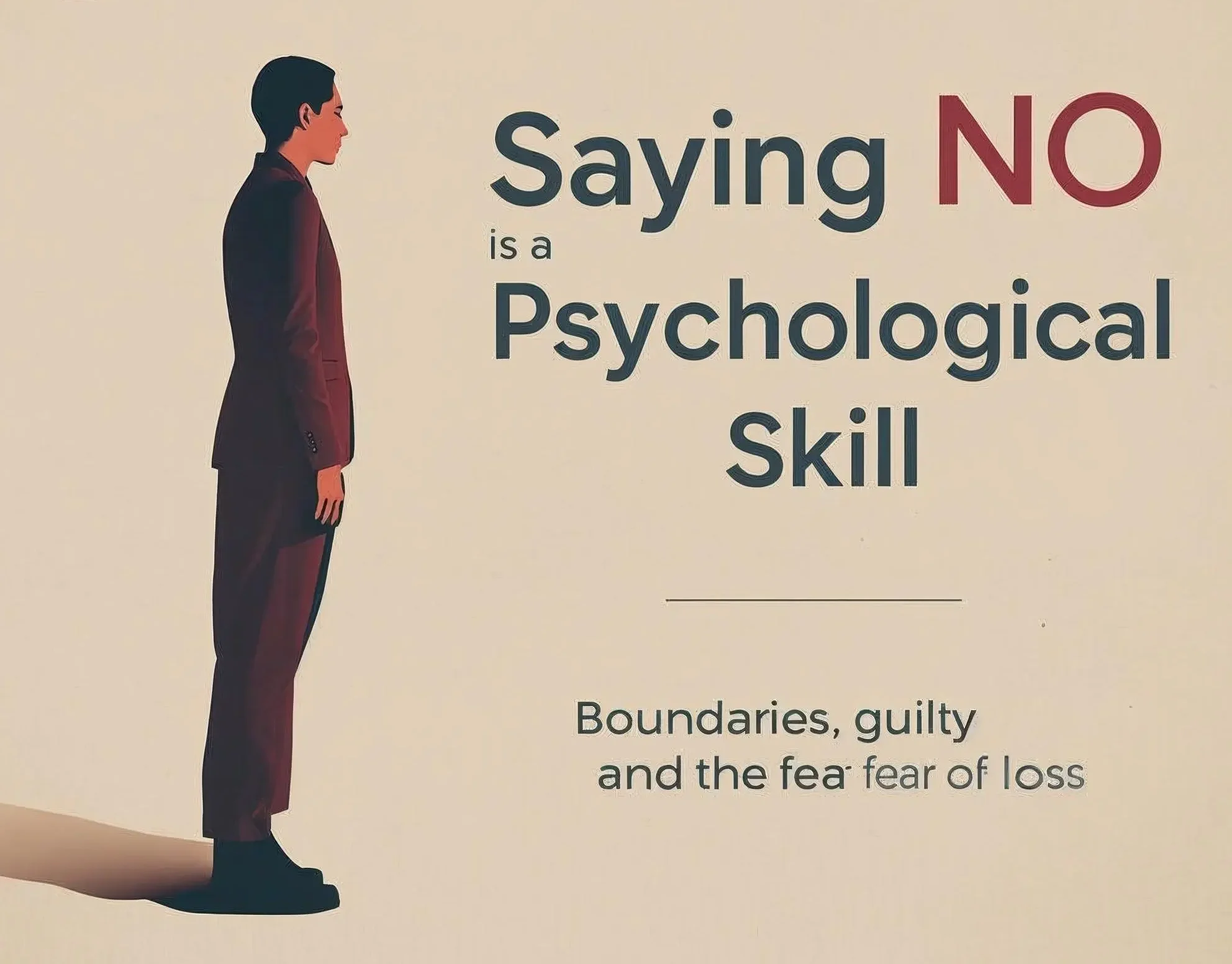
Why “No” Is a Psychological Skill, Not a Character Flaw
In psychotherapy, difficulty saying “no” is rarely related to weak character.
Much more often, it is connected to early learned relational patterns.
People who struggle with boundaries are most often those who:
- were rewarded when they adapted
- received attention when they were “easy”
- learned that conflict means losing connection
The psyche stores this as a survival rule.
That is why “no” is not experienced as a choice, but as a threat.
What gets activated when a person says “no”?
From a clinical perspective, the following are most commonly activated:
- anxiety about rejection
- guilt, especially in people with a strong superego
- fantasies of catastrophic consequences
This is not rational,
but it is emotionally consistent with the past.
It is important to make a distinction:
- guilt does not mean you made the wrong decision
- guilt most often means you broke an old role
Why explaining doesn’t help
Many people believe the problem will be solved if they “explain it nicely.”
It won’t.
Excessive explaining is a signal that:
- you are still asking for permission
- you are still trying to control the other person’s reaction
A healthy boundary:
- does not require persuasion
- does not require justification
- requires internal agreement
What “no” looks like when you stop lying to yourself
For a long time, I believed I was professionally stable.
- I had emotional language
- I had knowledge
- I had insight
And yet, privately, my “yes” was automatic.
Not because I didn’t know better,
but because knowledge does not protect you from habits.
Where I first noticed the problem
Not in relationships with “difficult” people.
But with those who were:
- polite
- decent
- well-intentioned
Where there is no obvious abuse,
boundaries are most easily blurred.
The pattern looked like this:
- I agreed
- then I became resentful
- then I became exhausted
- then I wondered what was wrong with me
At one point, I had to be brutally honest with myself:
I was not a victim of other people’s expectations,
I was their accomplice.
The first “no” was not a heroic moment
There was no sense of power.
There was fear.
There was:
- bodily tension
- persistent doubt
- thoughts such as:
- “Maybe I’m overreacting”
- “Maybe I’m ungrateful”
- “Maybe there will be consequences”
And yes, some people were genuinely disappointed.
That was the lesson.
Institutional and workplace context
In institutional and work environments, “no” is even harder because:
- it is not only about a personal boundary
- but about disrupting an established order
When you are used to being:
- the one who keeps the system functional
- the one who steps in when something falls apart
- the one who leaves no empty space
every “no” looks like a threat to stability.
Not because you are irreplaceable,
but because systems often rely on people who do not set boundaries.
In such environments:
- adaptability is rewarded
- exhaustion is taken for granted
- boundaries quietly turn into a sense of duty
This is where silent erosion happens.
What I learned as a psychotherapist and as a human being
- people who value you for who you are will adapt
- people who value you for how much you accommodate them will get angry or disappear
This is not a tragedy.
It is a diagnosis of relationships.
“No” as a therapeutic act
Today, “no” for me:
- is not rebellion
- is not defense
- is not coldness
It is a form of psychological self-regulation.
- I do not say it to change others
- I say it so I do not abandon myself
As a psychotherapist, I know:
- you cannot be present for others if you are constantly losing yourself
As a human being, I know:
- this is not learned overnight
Final point
- you do not have to say “no” to everything
- but you do have to stop saying “yes” to things that drain you
- you do not need everyone to understand you
- but you do need to understand yourself
And most importantly:
- boundaries are not walls
- they are doors
- and you decide when and for whom they are open












Post Comment